
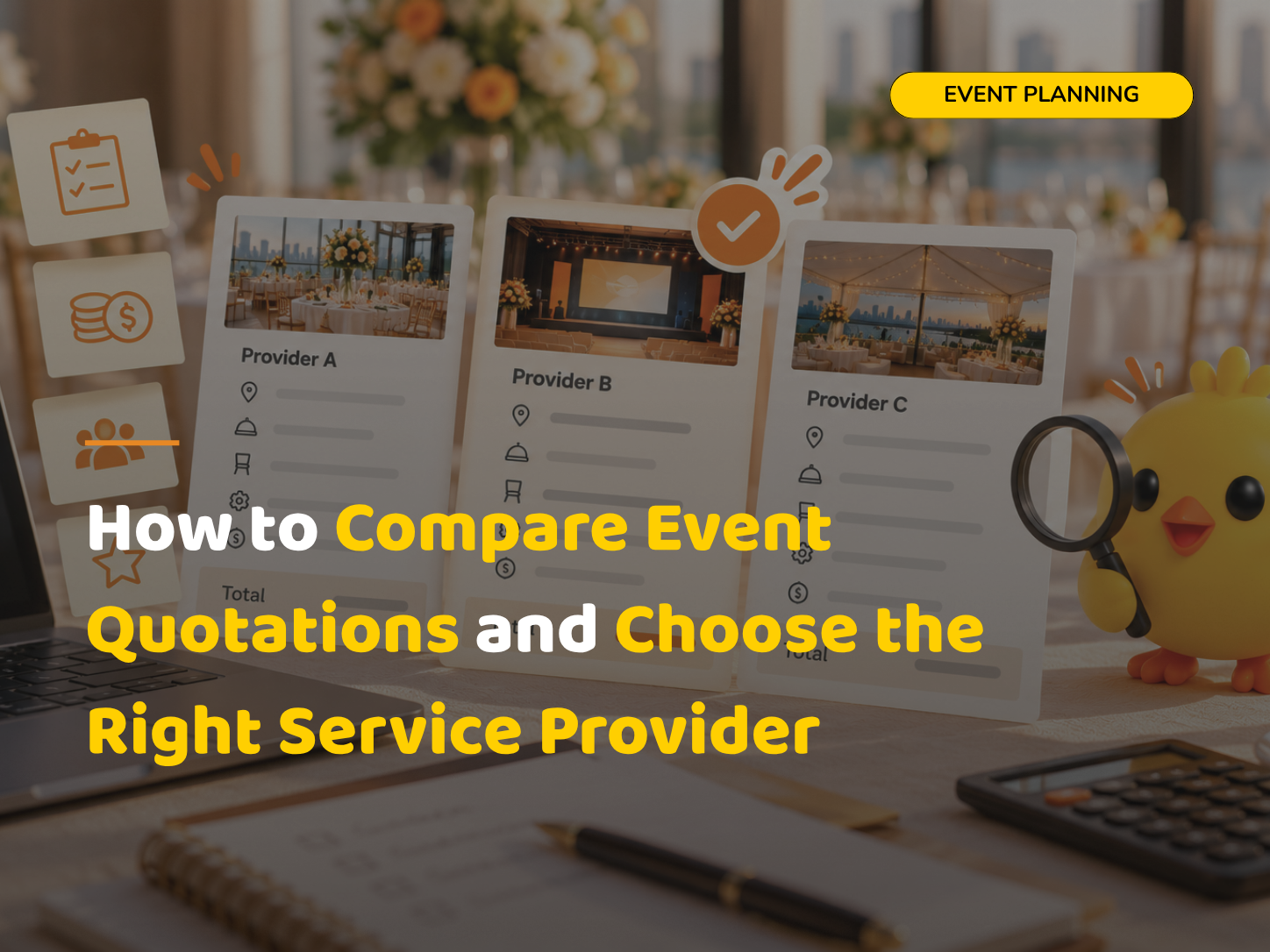
You’ve sent out your brief and three quotations are back. One is S$4,800, one is S$7,200, and one is a single line that says “Package B – S$5,500”. Which one is actually the best deal?
To compare event quotations properly, you need to look past the total. Line items, inclusions, assumptions and payment terms decide what you really pay and what you actually get on the day.
Quick answer: Get 3 quotations from suppliers who received the same written brief. Break each quote into the same line items, note what is included and excluded, and add GST, surcharges and likely extras to find the true cost. Then weigh price against experience, responsiveness, reviews and contract terms. The cheapest quote is rarely the best value.
This guide walks you through the process step by step, with a checklist you can use for any event quotation in Singapore, from corporate dinners and product launches to weddings and private parties.
How many event quotations should you get?
Three quotations is the right number for most events. Three gives you a clear price range and shows you which supplier is an outlier, without burying you in follow-up calls. For large or complex events, such as a 500-guest gala or a multi-day conference, four or five is reasonable.
More than five usually backfires. Each extra quote means another round of questions, and good suppliers often deprioritise briefs they suspect are being sent to everyone.
The number matters less than consistency. Every supplier should receive the same written brief, including:
- Event date, start and end time, and setup/teardown windows
- Venue (or venue shortlist) and guest count
- Scope of services needed, such as AV, catering, décor, staffing or emcee
- Budget range, if you have one
- Must-haves versus nice-to-haves
- The date you need the quotation by
Without a shared brief, you aren’t comparing event services. You’re comparing three suppliers’ guesses about what you want.
How do you compare event quotations? A 6-step method
Compare event quotations by normalising them into the same line items, then weighing true cost against quality and risk. Here is the process.
- Check that each quote matches your brief. Confirm the date, guest count, hours and scope are correct. A quote built for 150 guests can’t be compared with one built for 200.
- Break every quote into the same line items. Create a simple spreadsheet with rows for venue, catering, AV, décor, staffing, logistics and admin. Slot each supplier’s prices into those rows. Package pricing often hides what each element costs, so ask for a breakdown if one isn’t given.
- List inclusions and exclusions side by side. One supplier may include setup crew, delivery and a technician on standby. Another may charge for each separately. Gaps here explain most of the difference in event pricing.
- Calculate the true total. Add GST if it isn’t shown, plus service charges, overtime rates, transport, after-hours or public holiday surcharges, and any items you’d still need to buy separately.
- Review the terms, not just the numbers. Compare deposit amounts, payment schedules, cancellation and postponement policies, how long the quote is valid, and what happens if guest numbers change.
- Score quality and fit. Look at portfolio, reviews, relevant experience with your event type, and how quickly and clearly the supplier answered your questions. Responsiveness during quoting is a strong preview of responsiveness on event day
Once you’ve done this, the “expensive” quote often turns out to be similar in price, just more complete.
Should you choose the cheapest event quotation?
Not by default. The cheapest quotation is often cheapest because something is missing: fewer staff, older equipment, no on-site manager, or items you’ll be billed for later. Choose the quote with the best value for your priorities, not the lowest headline number.
A low quote can still be the right choice when:
- It covers the same scope as the others after you normalise the line items
- The supplier has solid reviews for events of your size and type
- Terms on deposits, cancellation and changes are reasonable
Be cautious when one quote is 25–30% or more below the others. Ask the supplier directly what explains the gap. A good supplier will give a clear answer, such as owning their equipment instead of renting it. A vague answer is a warning sign.
It also helps to think about the cost of failure. If the sound system cuts out during the CEO’s speech or catering runs short at a wedding, the money saved rarely feels worth it. For high-visibility events, reliability is part of the price.
Red flags in an event quotation
Watch for these when reviewing quotes:
- One-line pricing with no breakdown, and reluctance to provide one
- Vague terms like “basic setup” or “standard décor” with no description or photos
- No mention of GST when the supplier is GST-registered
- Large upfront deposits, such as 80–100% well before the event, with no clear refund terms
- Pressure to sign quickly with “today only” pricing
- No written contract or terms and conditions
- Unclear overtime rules, especially for venues and AV crews
What to know about event quotations in Singapore
A few local details often catch planners out when comparing an event quotation in Singapore:
- GST is 9%. GST-registered suppliers must charge it, but some quote prices before GST. Always check whether the total is “nett” or “++”. In venue and catering quotes, “++” usually means service charge and GST are added on top.
- Venue rules affect supplier costs. Many hotels and venues require approved vendors, charge load-in fees, or limit setup times. Confirm these before comparing AV or décor quotes.
- Peak periods cost more. Year-end corporate season, auspicious wedding dates and public holidays often carry higher rates or minimum spends.
- Permits may apply. Some public or outdoor events need licences or approvals. Ask whether the supplier handles these or whether it’s your responsibility.
Choosing event suppliers: 8 questions to ask before you book
Once you’ve narrowed it to two finalists, these questions make choosing event suppliers much easier:
- Can you share examples of similar events you’ve done recently, ideally at the same venue?
- Who will be our main contact, and will they be on-site on the day?
- What exactly is included, and what would cost extra?
- What happens if our guest count changes by 10–20%?
- What is your backup plan if equipment fails or a staff member is unwell?
- What is your cancellation and postponement policy?
- Do you carry public liability insurance?
- Can we speak to a recent client as a reference?
The way a supplier answers is as useful as the answers themselves. Clear, specific responses usually signal a well-run operation.
Negotiating after you compare
Comparing quotes also gives you leverage. You can ask your preferred supplier to match an inclusion another supplier offered, adjust the payment schedule, or remove items you don’t need. Focus on value, not just discounts. A complimentary extra hour or an added technician is often easier for a supplier to give than a price cut.
Frequently Asked Questions
How do I compare event quotations?
Send every supplier the same written brief, then break each quote into the same line items. Compare inclusions and exclusions, add GST and likely extras to get the true total, and review payment and cancellation terms. Finally, weigh cost against experience, reviews and responsiveness.
How many quotes should I get for an event?
Three quotes is ideal for most events. It gives you a reliable price range without overwhelming you. For large or complex events, four to five quotes is reasonable. Getting more than five rarely improves your decision and slows down planning.
Should I choose the cheapest quotation?
Not automatically. The cheapest quote often leaves out staff, equipment quality or services you’ll pay for later. Choose the quote that offers the best value for your priorities. If one quote is far lower than the others, ask the supplier to explain the difference before deciding.
What should an event quotation include?
A good quotation lists each service with its price, the quantities and hours covered, setup and teardown, staffing, GST, payment terms, cancellation policy and how long the quote is valid.
How far in advance should I request event quotations in Singapore?
For corporate events and weddings, request quotes 3–6 months ahead. For peak periods like November–December, start earlier, as popular suppliers book out.
Conclusion
The best way to compare event quotations is to make them comparable first. Use one brief, one set of line items and one checklist. Then the real differences in value become obvious, and you can book with confidence.