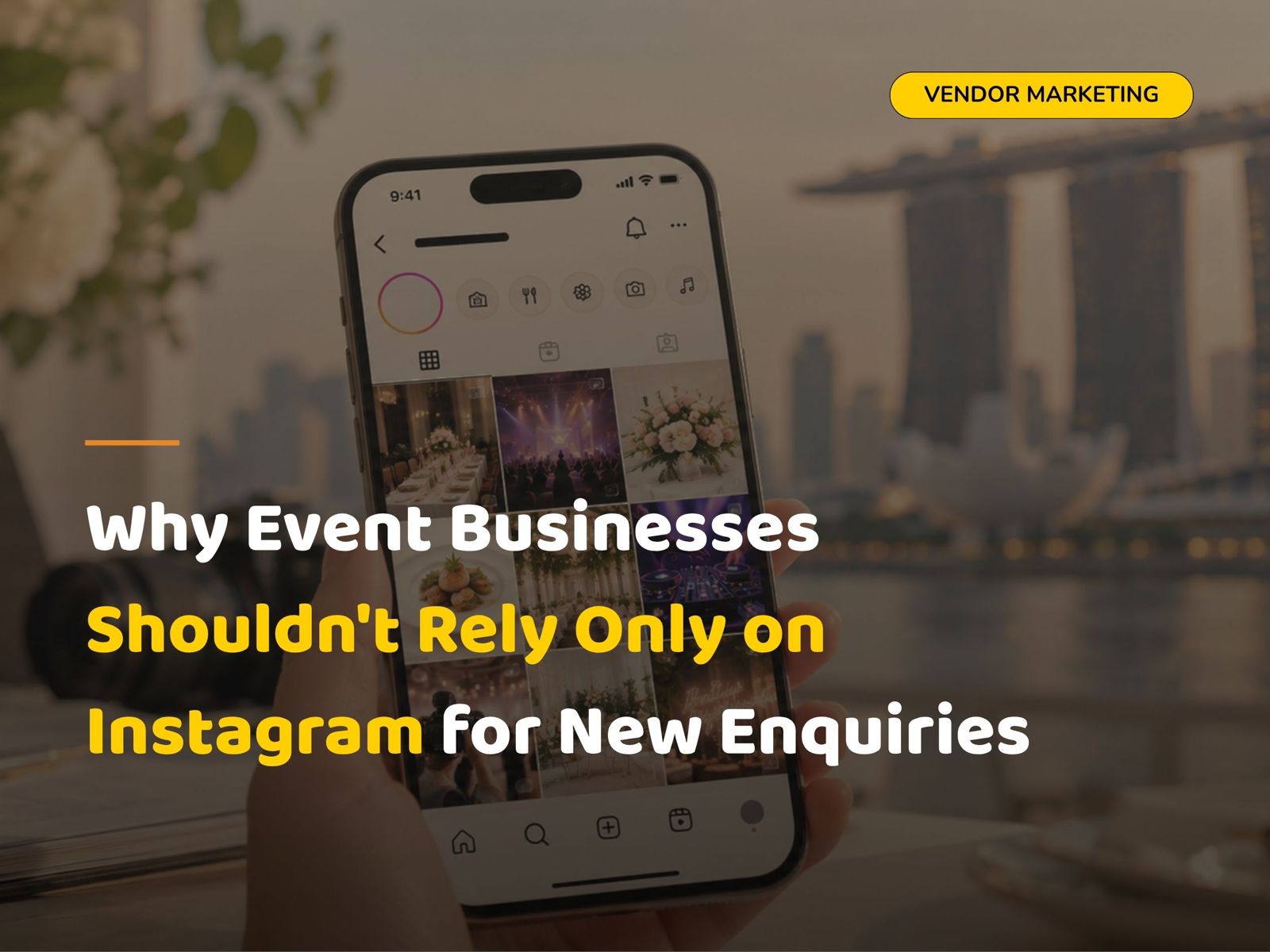
For many event businesses in Singapore, Instagram has become one of their most important marketing channels. A grid full of beautiful setups, a few Reels that did well, a steady trickle of DMs asking “hi, do you have availability in March?”
It works, until it doesn’t.
Reach drops. The DMs slow down. A competitor with weaker work but a better Google presence starts appearing in the quotation shortlists you used to win. Nothing about your service changed, but the enquiries did.
That is the core problem with Instagram-only marketing for event businesses: you are renting your entire pipeline from a platform that owes you nothing, and you are only visible to people who happen to scroll past you. This guide covers what Instagram is genuinely good at, where it leaves gaps, and which channels close those gaps.
Is Social Media Enough to Generate Leads for an Event Business?
Not on its own. Social media can generate awareness and enquiries, but relying on it as your only lead-generation channel makes your pipeline vulnerable.
The reason is timing. Instagram shows your work to people based on what the algorithm decides to distribute today. It does not show your work to a corporate HR executive at 3pm on a Tuesday, one hour after her manager asked her to source a venue, catering and an emcee for a Dinner & Dance in eight weeks.
That person may not be scrolling Instagram at that moment. She may search Google, ask colleagues, check supplier directories or use an event marketplace.
If Instagram is your only channel, you are invisible at the exact moment a decision is being made.
Social media works best as one layer inside a wider event business marketing system, not as the whole system.
Why Instagram Alone Is a Risky Foundation
Instagram marketing isn’t the problem. Depending on it exclusively is. Here is what that dependency actually costs you.
1. You don't own the audience
Your followers belong to the platform. An account restriction, a hacked login, a change to how Reels are distributed, or a shift in what the algorithm favours can cut your reach overnight. Event businesses that lose an account often lose years of portfolio and client history with it.
An email list, a website and a marketplace profile are assets you control. A follower count is borrowed.
2. It reaches people at the wrong stage of intent
Discovery on Instagram is passive. Someone sees your work, saves it, and maybe remembers you months later. Discovery on Google or an event marketplace is active. Someone is already looking, already has a date, and often already has a budget.
Passive discovery builds awareness. Active-intent channels put your business in front of organisers who are already closer to making an enquiry.
3. Corporate decision-makers aren't always there
Weddings and private celebrations skew social. Corporate work often doesn’t. Procurement teams, HR executives, EAs and marketing managers sourcing a product launch or a company D&D are more likely to search Google, ask a colleague, reuse an existing supplier, or request quotations through a platform.
If corporate events are an important revenue stream, relying on Instagram alone can leave a significant gap in how corporate buyers discover your business.
4. Your work is hard to evaluate from a grid
An organiser comparing three caterers needs capacity, pricing bands, inclusions, dietary options and lead times. A carousel post rarely answers any of that, and asking in DMs is friction. Some organisers won’t bother.
5. You can't see what's working
Attribution on Instagram is thin. “We got a few DMs this month” is not a marketing report. Without knowing which channel produced which enquiry, you can’t decide where to put your next dollar or hour.
6. One channel means one point of failure
This is the simplest argument. If the clear majority of your enquiries come from one source, your lead-generation strategy is highly dependent on that channel.
What Instagram Is Genuinely Good At
None of this means posting less. Instagram still plays several important roles:
- Proof of quality. Event work is visual. Photos and Reels sell it faster than copy.
- Recency signals. Recent posts show you’re active and booking, which matters to nervous first-time clients.
- Personality and trust. Behind-the-scenes content makes a small team feel reliable rather than anonymous.
- The final check. Some organisers may find you elsewhere, then check your Instagram before enquiring.
Treat Instagram as your portfolio and credibility layer. Build discovery layers around it.
How Can I Get Event Enquiries Besides Instagram?
Here are several channels event service providers in Singapore can use to diversify how potential clients discover and enquire with them.
Google Search and your own website
Organisers search in plain language: corporate catering Singapore, event photographer Singapore, emcee for company dinner, team building venue Singapore.
To appear, your website needs pages that actually say those things. Replace vague brand lines like “creating unforgettable moments” with service-and-location clarity: “Corporate Event Catering in Singapore.” Give each major service its own page rather than burying five services in one. Add pricing guidance, capacity, inclusions and past event types so a visitor can self-qualify.
Google Business Profile
Free, underused, and one of the fastest wins in event business marketing. A complete profile with categories, service areas, photos of recent events and a steady flow of reviews puts you into map results and branded searches. Ask every satisfied client for a review while the event is still fresh.
Event marketplaces and directories
This is where demand is already concentrated. An organiser on a marketplace has an event, a date and a requirement. They aren’t browsing, they’re sourcing.
Marketplaces also solve the problem of the organiser who doesn’t know your company name and never will. They know they need “a venue, catering and an emcee,” and they start there.
HatchEvent works this way: Event Organisers create an event, the AI matches them with suitable vendors, and they request quotations from up to three vendors per category. Your listing puts you into that consideration set without you needing to win a Google ranking first.
If you want corporate work, this is where the buyers are. You don’t need daily posting. A clear company page, a founder profile that states plainly what you provide, and occasional posts showing recent corporate events are enough to make you credible when someone checks you out or searches for suppliers.
Referrals and supplier partnerships
The highest-trust channel and the cheapest. Venues refer caterers. Caterers refer emcees. Photographers refer AV providers. Pick five complementary businesses that serve your client type, meet them properly, and make it easy to recommend you by sending a short capability summary they can forward.
Email and past clients
A company that ran a networking event in March may run a product launch in July and a D&D in December. Most event businesses never follow up. A simple quarterly email to past clients with new packages and availability often outperforms months of posting.
AI search and assistants
Organisers increasingly ask ChatGPT, Gemini and Perplexity for shortlists and planning help. These tools pull from structured, clearly written web content, directories, reviews and marketplace listings. They do not pull from your Instagram grid. Content that answers real questions in plain language is what gets you cited.
Paid Ads
Useful, but only after the basics. Paid traffic sent to a page that doesn’t explain your service, show your work or make enquiry easy just buys you expensive bounces.
Where Else Should I Promote My Event Business?
Different channels do different jobs. The mistake is expecting one channel to do all of them.
| Channel | Main role | Customer intent |
|---|---|---|
| Google / SEO | Capture active search demand | High |
| Google Business Profile | Local discovery and reviews | High |
| Event marketplaces | Reach organisers actively sourcing | High |
| Instagram / TikTok | Showcase work and build credibility | Low–Medium |
| Corporate visibility and credibility | Medium | |
| Referrals / partnerships | Warm introductions and trust | High |
| Email / past clients | Repeat business and reactivation | High |
| Paid ads | Expand targeted reach | Medium–High |
The goal isn’t to be everywhere. It’s to have three or four channels working so no single one can take your business down with it.
How to Tell If Your Marketing Is Too Instagram-Dependent
Run this check honestly:
- Can you name where your last ten enquiries came from? If not, you have no attribution.
- Does one channel account for the clear majority of your enquiries?
- If your Instagram account disappeared tomorrow, how would a new client find you this week?
- Do you have any way to contact past clients that doesn’t depend on a social platform?
- If someone searches your main service plus “Singapore,” do you appear anywhere on page one?
- Are you listed anywhere an organiser might be actively sourcing right now?
Two or more uncomfortable answers means diversification is the highest-value marketing work you can do this quarter.
A Realistic 90-Day Plan for a Small Event Business
You don’t need a marketing team. You need a sequence.
Days 1–30: fix the foundation. Claim and complete your Google Business Profile. Rewrite your homepage headline to state your service and location. Create one dedicated page for your highest-margin service. Start asking every client for a review.
Days 31–60: add active-intent channels. Create your listing on an event marketplace so you appear when organisers are sourcing. Tidy your LinkedIn company page. Export your past client list into a simple spreadsheet or CRM.
Days 61–90: build the compounding layer. Publish two or three pages answering questions clients actually ask you (pricing ranges, what’s included, lead times). Contact five complementary suppliers about referrals. Send one email to past clients. Keep posting on Instagram throughout, but now it supports a system instead of being the system.
What to Track
Keep it simple. Log every enquiry with: date received, source, event type, event date, estimated attendance, budget if given, quotation sent, and outcome.
After 90 days you’ll know which channels produce enquiries, which produce enquiries that actually close, and where your next hour of effort belongs. That single spreadsheet is worth more than most marketing advice.
Frequently Asked Questions
How can I get event enquiries besides Instagram?
Build channels that reach people who are actively looking rather than passively scrolling. The most effective options are Google search and a service-clear website, a complete Google Business Profile with reviews, listings on event marketplaces where organisers request quotations, LinkedIn for corporate buyers, supplier referral partnerships, and email follow-up with past clients.
Where else should I promote my event business in Singapore?
Prioritise places where Event Organisers are already sourcing: Google, Google Maps, event marketplaces and directories, LinkedIn for corporate work, and industry or supplier networks. Social platforms like Instagram and TikTok remain valuable for showcasing work, but they should sit alongside these discovery channels rather than replace them.
Is social media enough to generate leads?
Rarely on its own. Social media builds awareness and proves quality, but it reaches people based on algorithmic distribution rather than intent. Lead generation becomes predictable when social media is combined with search visibility, marketplace presence, referrals and direct client relationships.
Should I stop posting on Instagram?
No. Instagram is often the final credibility check before an organiser makes contact, and event work is inherently visual. The change is one of role: use Instagram to prove quality and stay visible to people who already know you, and build separate channels to reach people who don’t.
How many marketing channels does a small event business need?
Three to four active channels is usually enough. A practical combination is Google plus a clear website, a marketplace listing, referrals from complementary suppliers, and social media as the portfolio layer. Beyond that, most small teams spread themselves too thin to do any channel well.
How long does it take to reduce Instagram dependency?
Marketplace listings and referral conversations can produce enquiries within weeks. Google Business Profile improvements typically show within a month or two. SEO usually takes three to six months to compound. Starting all three at once means you have short-term and long-term channels running in parallel.
Build More Ways to Be Found
An Event Organiser cannot enquire with a business they never find. Strong work, fair pricing and fast replies only matter after discovery happens.
Instagram is one way to be discovered. It shouldn’t be the only one.
HatchEvent connects Event Organisers with event service providers across venues, catering, AV, entertainment, photography and more, giving your business another route to reach people who are actively planning and sourcing right now.
Join HatchEvent as an event service provider and start appearing where Event Organisers are already looking.
For more on building a steady pipeline, read How Event Businesses Can Get More Corporate Event Enquiries in Singapore.
